



BACK TO HOME
Sap & Syrup

Hydrometer use tips from the experts
Peter Gregg | March 13, 2026
RANDOLPH, Vt.—Sugarmakers should use hydrometers carefully, according to University of Vermont Extension.
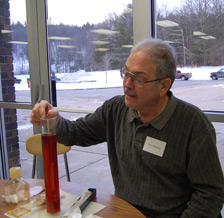
A hydrometer is a thin glass tube with printed graduations that floats in syrup to measure density. Cold syrup makes it float higher, while hot syrup makes it sink lower.
Most hydrometers have “hot test” and “cold test” lines. The cold test line shows the minimum legal density at the calibrated temperature, while the hot test line helps estimate density in syrup coming directly from the evaporator.
Knowing the syrup temperature is critical. Syrup that has cooled can appear denser than it actually is, resulting in syrup below the legal density. In Vermont, the legal density is 66.9 degrees Brix.
Hydrometers are delicate and should be checked periodically for accuracy. When buying a new one, producers should look for hydrometers tested and certified by the state of Vermont.
Read the point where the syrup crosses the stem, not the curved surface known as the meniscus. Lower the hydrometer gently into the syrup rather than pouring syrup over it. [ MORE ]

Sugarmakers discuss how much DE to use when filtering
Peter Gregg | February 26, 2026
ANTIGO, Wis. — Watch the filter “cake.”
That’s the advice from Jim Adamski of Adamski’s Sugar Bush in Antigo, Wis., a CDL dealer and president of the North American Maple Syrup Council.
“If you’re using too much DE, the cake will be solid as a rock,” Adamski said. “If it crumbles and breaks apart, you know you used too much.”
Diatomaceous earth, or DE, is the filter aid that removes niter and other solids. Too little or too much can cause problems.
After running a filter press, producers should see a firm, beige cake between the plates.
Early-season syrup typically filters easily. As the season progresses, more DE is often needed.
When syrup turns stringy or ropy, filtering will not correct the problem.
“If you get to that point, you need to stop boiling,” Adamski said. [ MORE ]
Filtering on gravity, the basics of cone filters
Peter Gregg | January 12, 2026
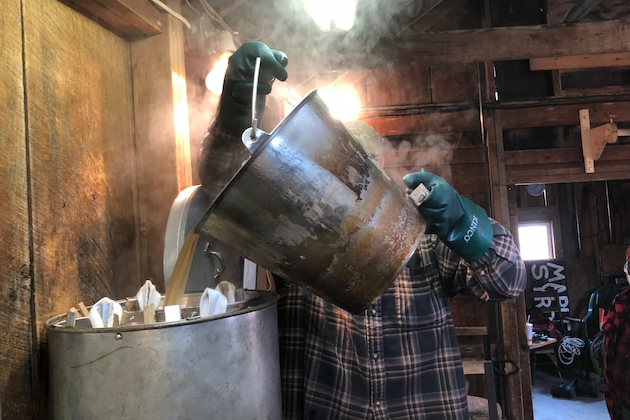
THOMASTON, Conn.— Small-scale maple producers often struggle with gravity cone filters, but proper technique can make the process far more efficient.
“Cone filters must be damp and they must be hot,” said sugarmaking legend Bruce Gillilan of Fletcher, Vt., the featured speaker at the Connecticut maple meeting Jan. 10.
Gillilan shared several tips to help small producers improve their filtering results. He recommended hanging synthetic or wool cone filters from a hook over the back pan to capture steam and keep the filter damp.
“We want it damp, but not wet,” he said.
Cleanliness is critical, Gillilan emphasized. Filter bags should be kept as clean as possible. [ MORE ]
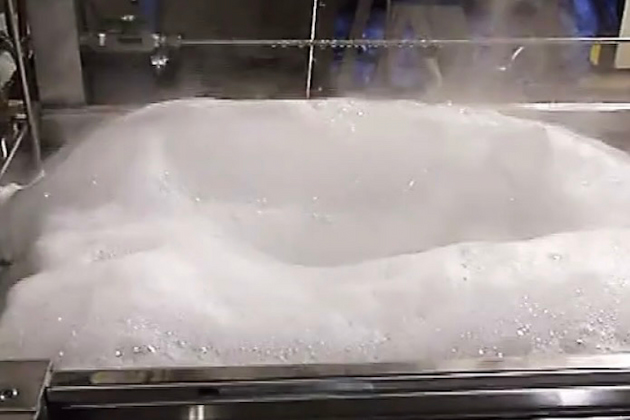
Researchers examine defoamer use and foam control
Peter Gregg | January 12, 2026
UNDERHILL, Vt. — Ongoing research confirms what many in the industry have long suspected: organic sugarmakers use significantly more defoamer than conventional producers, often leaving residue behind.
“Flavor or mouthfeel can be affected if too much defoamer is used,” said Mark Isselhardt of UVM Extension during a presentation at Vermont Maple Conference week, hosted by the Vermont Maple Sugar Makers’ Association. “We want to use as little as possible.”
Residue can accumulate along the edges of evaporator pans and in filter presses, Isselhardt said.
Improperly stored defoamer can also turn rancid and develop off flavors, underscoring the importance of freshness and proper storage.
A joint study involving the UVM Proctor Maple Research Center, Centre ACER in Quebec, the University of Maine, and the Cornell Maple Program is examining defoamer use and strategies to reduce overapplication.
Sugarmakers in Vermont, Maine, and New York voluntarily participated by keeping detailed journals of defoamer use throughout the 2025 season. [ MORE ]
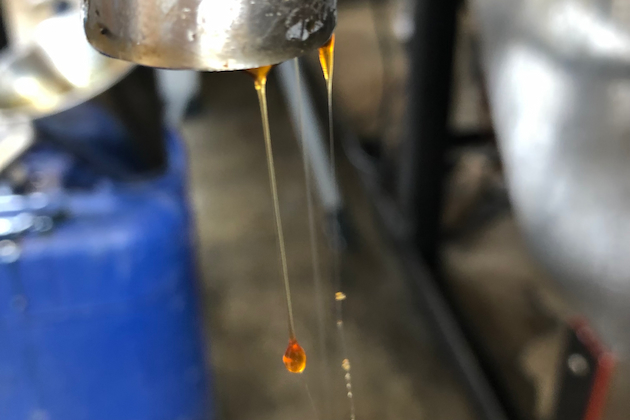
Test strips for buddy sap being developed
B.W. (Bev) Campbell, OMSPA | June 11, 2024
OTTAWA, Ont.???��???Buddy Sap is a mystery to many maple producers.
You can???��?�?t see it, and you often can???��?�?t smell or taste it at the sap stage.
Only after investing considerable effort and energy into boiling it down to syrup does the off flavor become apparent. Sometimes it takes on a burnt ???��?�Tootsie Roll???��?? flavor.
Now an Ontario research team from Carlton University in Ottawa is developing a test strip to detect buddy sap.
Shahad Abdulmawjood, a Carlton University PhD candidate in chemistry, working with more than a dozen Ontario maple producers, conducted a trial this season of the first prototype buddy sap test kit.
The test uses a solution and a test strip.
[ MORE ]
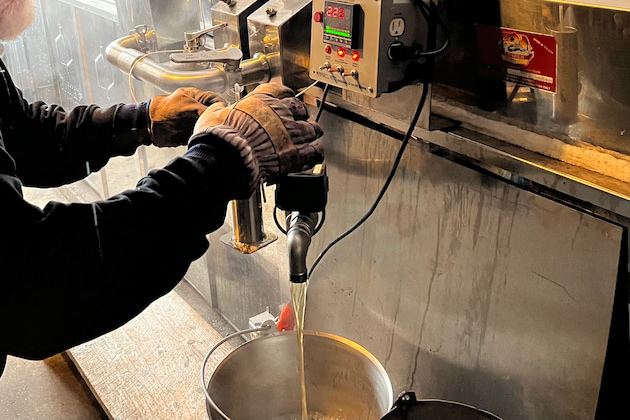
Sugarmakers encouraged to check hydrometers this season
Peter Gregg | February 21, 2024
MORRISVILLE, Vt.—Check your hydrometers!
Sugarmakers are encouraged to check hydrometers or make sure new hydrometers have been certified by the Vermont Department of Agriculture.
A recent survey by the University of Vermont Extension Service found that many syrups bought online were out of density compliance.
Extension agents bought online a total of 166 samples in 2021 and 182 samples in 2023.
Nearly 1 in 4 containers (22%) failed to meet the minimum density standard (66.9 ⁰Brix) for pure maple syrup, UVM reported.
Many state maple associations or departments of agriculture offer hydrometer testing.
At a clinic in Connecticut last month, 5 hydrometers failedout of approximately 25 tested.
[ MORE ]
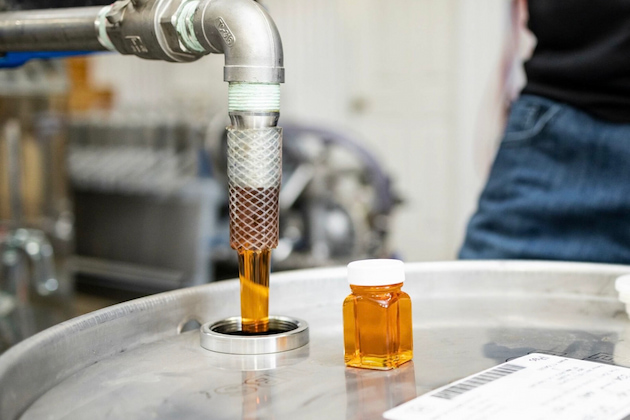
Strategic reserve nearing empty in Quebec
Peter Gregg | November 14, 2023
LONGUEUIL, Que.—The Global Strategic Reserve of maple syrup in Quebec is down to less than 15 million pounds, officials said.
Of that, all of the remaining syrup is organic.
The drainage of the reserve comes after one of the shortest crops in Quebec in recent history, combined with reportedly all-time high demand for syrup across the globe and in the U.S. in particular.
Quebec’s maple harvest totaled 124 million pounds this season, the smallest crop in five years, off dramatically from 211 million pounds in 2022.
Still, officials for the Quebec maple federation did not seem concerned.
“We are confident of being able to replenish it following the emissions of 7 million taps in 2021 and 2023,” said Joël Vaudeville, spokesman for the federation.
The federation increased its government-sanctioned tap quota to accommodate a massive increase in syrup demand during the pandemic. [ MORE ]
Survey reveals sap selling potential
Dana Ruppert | October 17, 2023
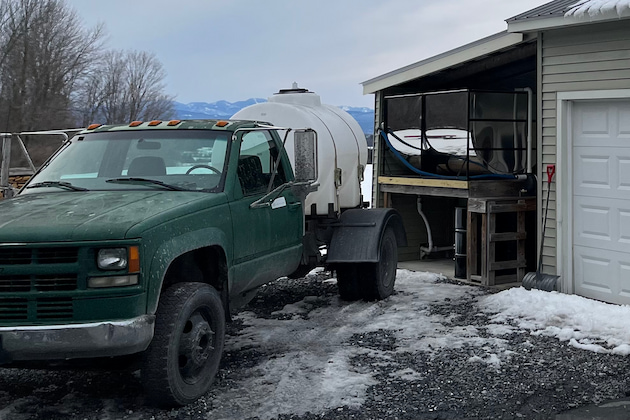
BRATTLEBORO, Vt.—There are opportunities in sap selling.
In a recent survery in Vermont, a majority of respondents reported they could accept additional sap in their facility without having to make changes to current systems.
As part of the Sap Business Promotion project, the University of Vermont Extension surveyed maple producers in the Northeast to explore the prevalence and possibility of sap selling and buying in the maple sector.
Surveys were completed by 128 producers across several states.
The majority of maple producers in this survey were producing their own sap and processing it into syrup, and 63% of participants were not participating in any sap buying or selling.
[ MORE ]













Special
Subscription
Fall
Sale!
© 2026 The Maple News