


BACK TO HOME
Tapping & Tubing
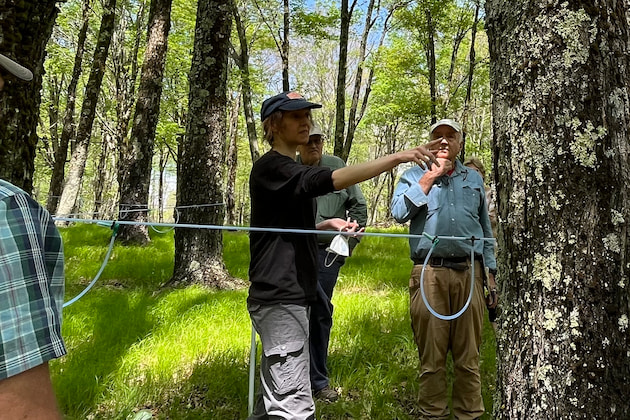
Don't give up on the 3/16ths just yet
Peter Gregg | July 9, 2026
FRANKLIN, W.Va. — Maybe 3/16-inch tubing deserves a second chance.
After riding a wave of excitement followed by disappointment for many producers, researchers are offering new guidance on where the technology works best — and how to avoid the yield declines that have frustrated sugarmakers.
"3/16ths is something you use for specific situations," said Abby van den Berg, an advisor with the Future Generations University maple program in West Virginia and former researcher at the University of Vermont.
"Where are they a good fit? You have to have slope! Fifteen percent or greater," she said during a recent seminar.
Van den Berg acknowledged that many producers have experienced the so-called "second-year decline," where a strong first season is followed by a significant drop in production.
To address those concerns, van den Berg and fellow researchers recently published a guidebook titled Maple Sap Collection Using Natural Vacuum in 3/16-Inch Tubing.
"Hot off the presses today," van den Berg said. [ MORE ]

Avoid stained wood when tapping
Peter Gregg | February 4, 2026
UNDERHILL, Vt.— As sugarmakers begin tapping for the 2026 season, experts urge extra care in finding clean tapping surfaces.
Avoiding old tapholes is essential, researchers say.
White shavings indicate healthy, conductive wood, while brown shavings signal stained wood.
“You will get 75 percent less sap if you tap into stained wood,” says University of Vermont Extension maple specialist Mark Isselhardt.
UVM research shows tapping into non-conductive wood sharply reduces sap yield.
Tapholes placed too close to previous taps often strike brown, unproductive tissue.
Each taphole creates non-conductive wood that persists into future seasons.
Staining usually runs vertically from an old taphole, though not always, Isselhardt said. [ MORE ]

Tapping tips from the experts, as new season begins
Peter Gregg | January 12, 2026
EDEN, Vt. — As sugarmakers head back into the woods in the coming weeks, experts say proper tapping technique should be top of mind.
Ideal tapping depth, researchers agree, is no more than two inches.
Also, only one tap per tree, is the rule of thumb for most professional sugarmakers.
Veteran sugarmaker Glenn Goodrich has long emphasized the importance of precision when drilling tapholes.
“Getting a true, round hole is essential,” Goodrich told producers during a recent seminar.
Goodrich, who runs a 160,000-tap operation in Eden, Vt. and Cabot, Vt., is widely regarded as one of the nation’s premier sugarmakers.
“I fire the drill at the highest speed it can spin,” he said, stopping at a depth of no more than two inches. [ MORE ]
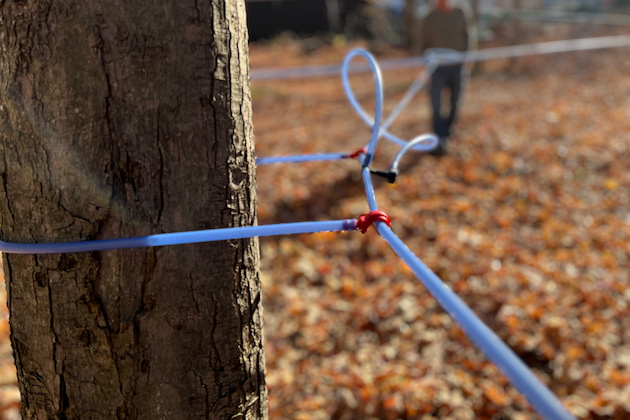
Vermont sugarmaker offers expert tubing tips
Peter Gregg | February 4, 2025
WESTMINSTER WEST, Vt.—Veteran sugarmaker Dan Crocker has been making syrup more than fifty years and over the past several seasons, he has achieved a 7lbs per tap average.
It didn’t always used to be that way.
The old benchmark for big-time Vermont sugarmakers—Crocker has 22,000 taps in southern Vermont—was an average of 5 pounds per tap, and he would hit that mark consistently.
But then he did the math, and found that for each one pound increase, he’d be putting an extra $40,000 in his pocket.
“The math is easy,” he told a group at the Lake Erie Maple Expo last fall. “That adds up fast.”
So he targeted 7lbs and has high hopes for 2025.
“And this season I’m going to be pushing 8 pounds,” he said. [ MORE ]
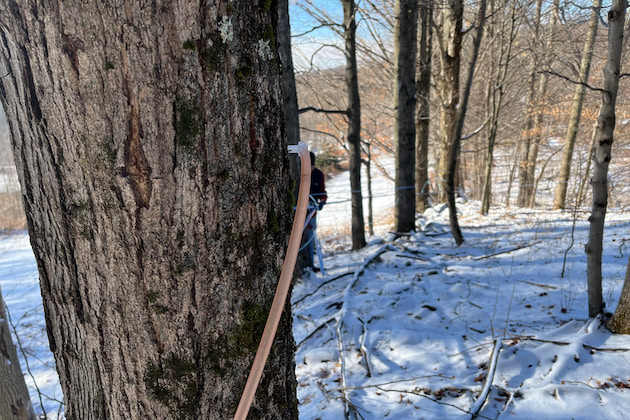
Sugarmakers prefer tapping frozen trees
Peter Gregg | January 15, 2025
SYRACUSE, N.Y.—A normal winter.
That’s how most sugarmakers are describing January of 2025 so far, with bitter cold temperatures and lots of snow all across the Maple Belt.
Meanwhile, the enthusiasm for January tapping seems to have diminished for some.
Last year at this time, many sugarmakers were making syrup already.
In fact, sugarmakers in traditionally cold areas like Wisconsin and Minnesota, even ones on gravity, we’re making January syrup last season.
This year not so much.
But that doesn’t mean producers should abandon plans to tap early in freezing cold temperatures. In fact, for many, it’s preferred. [ MORE ]

Does high vacuum 'create' leaks? Expert explains.
Michael Ruff, Becker Pumps Corp. | July 23, 2024
CUYAHOGA FALLS, Ohio—In recent years, the use of deep vacuum systems for maple extraction has sparked debate, with some concerns that these systems cause micro leaks in tree taps.
However, it’s crucial to distinguish fact from fiction.
Deep vacuum doesn’t create leaks; it merely exposes existing ones.
Before delving into the deep vacuum debate, let’s revisit the process of maple syrup extraction:
■ During the sugaring season, small holes are drilled into maple tree trunks to create taps. These taps allow sap to flow out for collection and sub- sequent processing.
■ Traditionally, gravity has been the primary force drawing sap from the trees into collection containers.
■ Technological advancements have intro- duced vacuum systems that significantly enhance sap extraction efficiency.
[ MORE ]
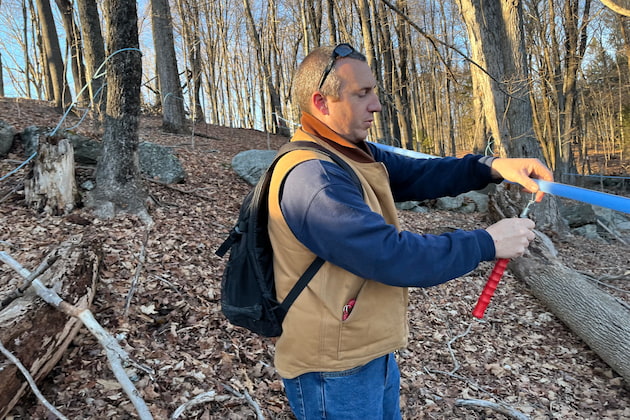
Producers encouraged to find their 20-day 'money window'
Peter Gregg | January 16, 2024
THOMASTON, Conn.—When to tap?
That’s always the sugarmaker dilemma every season but this year it seems more pronounced than others.
Wild weather and big temperature swings across the Maple Belt has had producers excited one minute and hesitant the next.
Contributing to the matter are Facebook posts from big producers who are forced to tap early because of the size of their operations, and capture early sap runs in December and January.
When to tap was the big topic of conversation this weekend at the annual meeting of the Maple Syrup Producers Association of Connecticut.
“I’m not sure when I’m going to start this season,” said Mat Wilkinson of 800-tap Wilkinson Maple Farm in Columbia, Conn.
Offering some perspective was the keynote speaker at the meeting Bradley Gillilan of Gillilan Family Maple in Fletcher, Vt. who is a tubing installer and consultant to sugarmakers across the nation.
[ MORE ]
Vermont sugarmaker offers tips on tubing cleaning
Peter Gregg | November 3, 2023
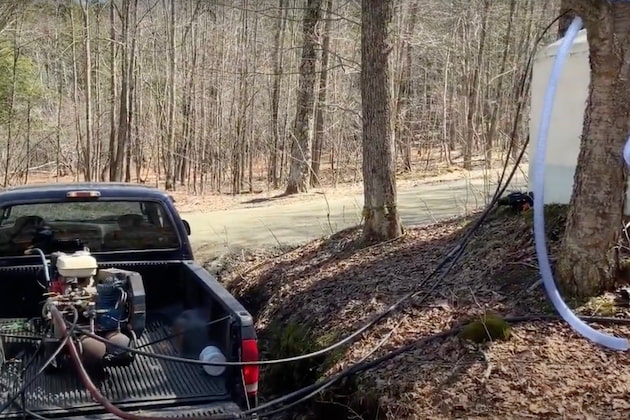
SOUTH WOODSTOCK, Vt.—One of the biggest debates in maple is over the best method for cleaning tubing, or even bothering to clean it at all.
At 1,200-tap Top Acres Farm in South Woodstock, Vt. sugarmaker Mary McCuaig has developed what she says is a tried and true method.
"We use a weaker chlorine solution and begin cleaning as soon as the season ends," she told The Maple News.
"This method has allowed us to avoid replacing spouts and droplines annually and still keep yields high," McCuaig said.
"We average over half gallon of syrup per tap, and our sap is clean, starting with the first sap run."
McCuaig has posted three YouTube videos explaining her method under her YouTube channel- marymccuaig3249. [ MORE ]













Special
Subscription
Fall
Sale!
© 2026 The Maple News