



Tapping & Tubing
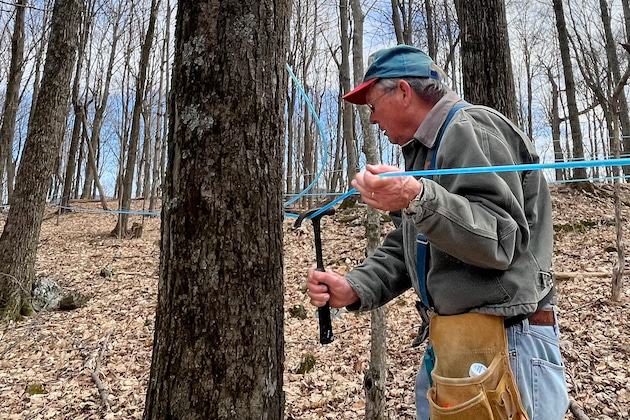
Don't give up on the 3/16ths just yet
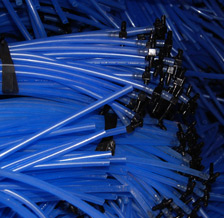
New Guidance for 3/16-Inch Tubing Systems
By PETER GREGG | JULY 9, 2026

FRANKLIN, W.Va. — Maybe 3/16-inch tubing deserves a second chance.
After riding a wave of excitement followed by disappointment for many producers, researchers are offering new guidance on where the technology works best — and how to avoid the yield declines that have frustrated sugarmakers.
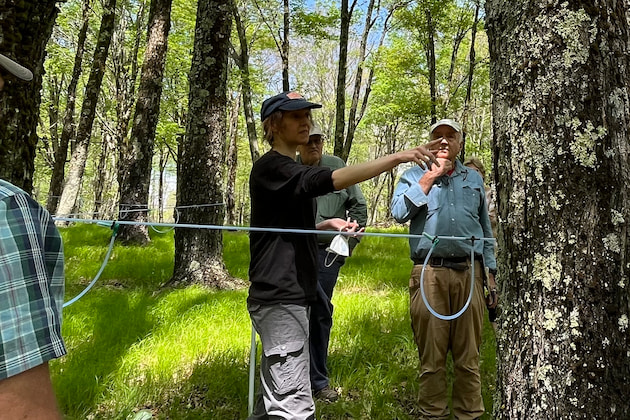
"3/16ths is something you use for specific situations," said Abby van den Berg, an advisor with the Future Generations University maple program in West Virginia and former researcher at the University of Vermont.
"Where are they a good fit? You have to have slope! Fifteen percent or greater," she said during a recent seminar.
Van den Berg acknowledged that many producers have experienced the so-called "second-year decline," where a strong first season is followed by a significant drop in production.
To address those concerns, van den Berg and fellow researchers recently published a guidebook titled Maple Sap Collection Using Natural Vacuum in 3/16-Inch Tubing.
"Hot off the presses today," van den Berg said.
"We wanted to fill in the gaps that we needed for 3/16ths tubing."
The publication was co-authored by van den Berg, Michael Rechlin, Yangiin Jung and Keith Heasley following years of field research and on-farm trials.
One of the major conclusions involves the number of taps that should be placed on a lateral line.
The magic number?
Fifteen.
"I have heard everything over the years — some high numbers, or even that there is 'no too many' taps on a line," van den Berg said.
Researchers examined factors such as sap velocity, friction, tree size, spacing and tap count. Tests were conducted in a sugarbush with a 20-percent slope and trees spaced approximately 30 feet apart.
"At a certain level, there becomes too much sap in the line. Too much friction," she said.
"It seems to happen at the 15-tap mark."
The other big factor? Sanitation.
She revealed a remarkable statistic: when properly sanitized with a chlorine solution, tubing can rebound to 86 percent of first-year production, year after year.
"The effects of sanitizing are quite good at maintaining high yields over time," van den Berg said.
Having "super steep slope" also helps clear out the lines.
"The higher the slope, the better, because it helps move stuff through the system and scour the system."
Clogging can occur in both tubing and fittings, reducing sap flow and vacuum.
She also recommends replacing drops and tees on a regular basis.
"Simply replacing spouts is not enough to maintain yields," she said. "Drops should be replaced as well."
Van den Berg said producers should not give up on the technology if they have the right conditions for it.
For producers without access to electricity or the resources to invest in a conventional vacuum system, 3/16-inch tubing remains a valuable option.
"If you're far away in the middle of nowhere, this is a great option," she said.
"The tubing is less expensive, requires little equipment, and can be a simple, low-cost sap collection system."
She said a hybrid approach can help overcome some of the technology's limitations.
Using a battery-powered diaphragm pump, for example, can help maintain vacuum and keep sap moving through the system.
"You don't need a giant pump with high CFM," van den Berg said. "A diaphragm pump is all that is needed to get the vacuum up. It keeps the sap moving, too."
But again, there are limits and variations in vacuum levels, no matter how much slope you have.
"Not all trees on a 3/16 line have the same level of vacuum," van den Berg said.
Trees near the collection tank generally experience lower vacuum levels than trees farther uphill.
The other key requirement: the system must be leak-free.
"A single squirrel chew on a 3/16 without a pump, that is a disaster," she said.













Fall
Sale!
© 2026 The Maple News