



Season Summaries
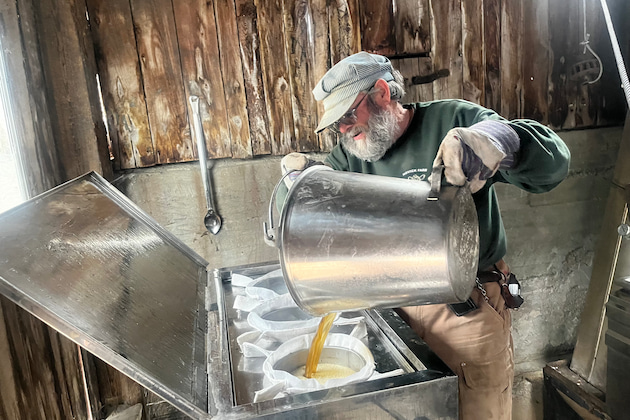
U.S. crop a near record 5.9 million gallons
Vermont, New York and Maine top 3
By PETER GREGG | JUNE 11, 2026

LYNDONVILLE, Vt.— U.S. maple producers made more syrup from fewer taps in 2026, pushing national production to a near record 5.88 million gallons despite a slight decline in tapping, according to USDA's annual maple syrup survey.
The United States produced 5.877 million gallons of maple syrup this year, up 3 percent from 5.701 million gallons in 2025.
Meanwhile, the number of taps fell to 16.47 million, down 1 percent from last year and nearly 4 percent below 2024 levels.
Producers averaged 0.357 gallons of syrup per tap in 2026, up from 0.342 gallons in each of the previous two years.
Vermont remained the nation's leading maple-producing state with 3.091 million gallons, accounting for nearly 53 percent of all U.S. production.
The state maintained 8.2 million taps and improved its yield to 0.377 gallons per tap, up from 0.367 gallons a year ago.
"Vermont producers had a strong season and still make over 50 percent of the U.S. maple syrup crop," the Vermont Maple Sugar Makers' Association said following the report's release.
According to USDA data, Vermont maple production has increased 572 percent over the past two decades, making it one of the fastest-growing sectors in the state's agricultural economy.
New York strengthened its hold on second place with 884,000 gallons, up 7 percent from 829,000 gallons in 2025.
The state's production increased despite a decline in tap numbers, as yield climbed from 0.307 to 0.340 gallons per tap.
Maine rebounded sharply and reclaimed third place nationally, producing 641,000 gallons, up 17 percent from last year's 549,000-gallon crop.
Yield improved from 0.312 to 0.366 gallons per tap while tap numbers remained relatively stable.
Wisconsin ranked fourth with 504,000 gallons.
Although production declined from the state's record 556,000 gallons in 2025, Wisconsin continued to post one of the nation's highest yields at 0.438 gallons per tap.
Michigan rounded out the top five with 203,000 gallons, slightly ahead of its 2025 production.
The 2026 season brought another weather roller coaster for producers.
Vermont experienced its coldest winter since 2014-15, with below-average temperatures throughout December, January and February.
Deep snow covered much of the state during tapping season, and many sugar makers reported a late start followed by intense sap runs in March.
By the end of January, Jay Peak had recorded more than 300 inches of snow. Many producers pulled out snowshoes to complete their tapping.
March 16 stood out as a pivotal day for many operations, with temperatures climbing to nearly 70 degrees and triggering some of the strongest sap flows of the season.
In VMSMA's annual crop survey, 41 percent of responding producers described the season as average, while 37 percent reported above-average or record-breaking crops.
Twenty-three percent reported below-average production.
The results varied widely by region and even by sugarbush.
Producers reporting above-average crops came from 10 counties across the state, while Chittenden County producers appeared on both ends of the spectrum, accounting for the largest share of both record-breaking and below-average crop reports.
"Had some of the biggest runs ever in a 24-hour period," one Orleans County producer reported.
An Addison County producer described a season marked by prolonged cold spells and dramatic swings in sap flow.
"It would run for several days straight with no break and then freeze up for several days straight, making it challenging from a schedule and sleep standpoint," the producer said.
"Otherwise pleased with the sap quality and sugar content."
Another producer from Caledonia County summed up the season as one of deep snow, a late start and massive sap runs.
"Extreme snow depth, later start, big runs then no activity, input costs up vs. price paid for syrup sales," the producer said.
Among smaller-producing states, Connecticut posted the largest percentage increase, with production rising 33 percent to 12,000 gallons.
Massachusetts increased 9 percent, while Pennsylvania reached a record 193,000 gallons.
West Virginia recorded the largest decline, falling 27 percent to 11,000 gallons.
The survey also showed modest growth in maple acreage nationwide.
Producers reported 310,800 acres devoted to maple production, up from 308,200 acres in 2025.
Vermont, Pennsylvania, Wisconsin and New Hampshire all reported increases in maple acreage.













Fall
Sale!
© 2026 The Maple News