



Sap & Syrup
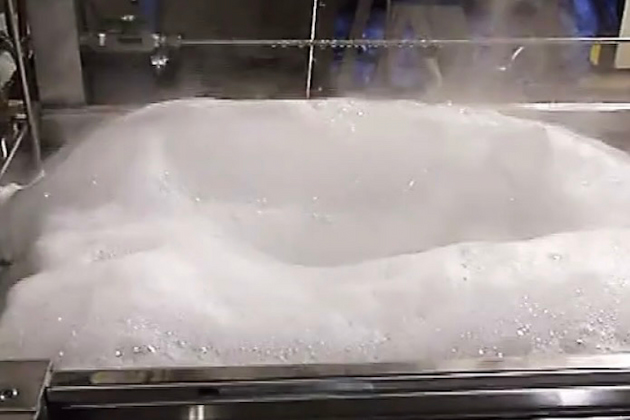
Researchers examine defoamer use and foam control
Organic production requires much more defoamer
By PETER GREGG | JANUARY 12, 2026

UNDERHILL, Vt. — Ongoing research confirms what many in the industry have long suspected: organic sugarmakers use significantly more defoamer than conventional producers, often leaving residue behind.
“Flavor or mouthfeel can be affected if too much defoamer is used,” said Mark Isselhardt of UVM Extension during a presentation at Vermont Maple Conference week, hosted by the Vermont Maple Sugar Makers’ Association. “We want to use as little as possible.”
Residue can accumulate along the edges of evaporator pans and in filter presses, Isselhardt said.
Improperly stored defoamer can also turn rancid and develop off flavors, underscoring the importance of freshness and proper storage.
A joint study involving the UVM Proctor Maple Research Center, Centre ACER in Quebec, the University of Maine, and the Cornell Maple Program is examining defoamer use and strategies to reduce overapplication.
Sugarmakers in Vermont, Maine, and New York voluntarily participated by keeping detailed journals of defoamer use throughout the 2025 season.
In some cases, the results were striking—particularly among organic producers, who are prohibited from using products such as Atmos 3000 or powdered defoamers.
Instead, they rely on cooking oils, which must be applied in much larger quantities to achieve the same effect.
“Conventional defoamer is more effective than organic, and now we have data to prove it,” said Nathalie Martin, Ph.D., of Centre ACER.
Although the study is still in its early stages, researchers noted an important trend: sugarmakers using electronic drip systems applied less defoamer than those adding it manually every 10 minutes.
Electronic drippers were far more common in Vermont than in Maine or New York.
Defoamer use also tended to spike at the beginning and end of the season.
“Amino acids and polysaccharides are more prevalent at the end of the season,” Martin said, contributing to increased foaming.
The research team plans to explore additional foam-control methods and conduct laboratory testing to quantify defoamer residues in finished syrup.
“There may be ways to reduce residue after the fact,” Isselhardt said, “but we first need to know how much is actually there.”
The ultimate goal, Martin said, is to develop clear, practical guidelines for producers.
In the meantime, researchers emphasized the importance of good sugarhouse practices to limit foaming.
“Clean carefully, prevent sap degradation as much as possible, keep it cold, and process rapidly,” Isselhardt said.













Fall
Sale!
© 2026 The Maple News